Showing posts with label Chris Eyre. Show all posts

Thursday, April 15, 2010

Week 9 and 10: The Evolution and Future of Native American Film

In addition to the eight films, a number of articles also capture the contempoary state of Native American Cinema.


Lastly, an article about where Native American film is headed: http://www.nativevue.org/blog/?p=513


I would also like to draw attention to a coming film, The Search for the World's Best Indian Taco. The film debuted in late March, and looks to have been very well-recieved. Perhaps up to the level of Smoke Signals? Only time will tell. In the meantime, here is the trailer: http://www.youtube.com/watch?v=266uzhhF25k


Week 8: California Indian (2008)

California Indian (2008)

Director: Tim Ramos
Producer: Chris Eyre, Richard Castaniero, Tim Ramos,
Writer: Tim Ramos
Rating: NR

Watch online: (available through netflix) http://www.netflix.com/Movie/California_Indian/70075040?strackid=2ea802ccad884c26_0_srl&strkid=1367101820_0_0&lnkctr=srchrd-sr&trkid=222336

Review/Biopic of the Writer-Director: http://www.nativevue.org/blog/?p=72

by Carole Levine

(I think this reveals some of the hardships faced by Native Americans in Hollywood. Tim Ramos could not find Native acting jobs... so he created some.)

"Tim Ramos’s first feature film, California Indian, won’t be seen by audiences until early next year. No matter, one thing is clear. This guy knows how to make a movie.

It doesn’t hurt that he is one smart cookie; well-spoken, thoughtful and savvy. But that isn’t enough in any business, especially this business, which chews and spits out dewy-eyed auteurs like tobacco cud. Tim has paid his dues, first as an actor, then as a student filmmaker. After landing a minor role in 1992’s The Last of the Mohicans, this member of California’s Pomo Tribe found Native roles virtually non-existent. Instead, he spent years scraping by accepting the few acting jobs available to a young indigenous male with a Hispanic-sounding name—mainly, being typecast as a Latino thug.

But, like I said, Ramos is a smart cookie and he wanted more than bit parts playing a punk. He decided to take matters into his own hands and learn how to produce a movie himself. He went back to school; not any school, mind you, but UCLA’s Film School, to earn a dual Master’s in American Indian Studies and Film with an emphasis on directing. Smart cookie.

By 1997, his life was on course, both personally and professionally. While at UCLA, he wrote and directed his first short film, Rancheria; married, became a dad; cognizant he had to earn a steady paycheck. For that reason, he accepted a position with his tribe, the Big Valley Rancheria (a California term for “reservation”) where he produced short videos about cultural preservation and revitalization. Within a year, Ramos established Against the Wind Films making PSA’s and industrial films.

He had his own company; he was making films. “Producing is producing, regardless of the content,” he says. With that in mind, the seed was planted. Tim Ramos was going to write, direct and act in his own movie.

“California Indian has been in development for eight years from the time I started formulating it to getting it on film,” he explains, adding that the story stems from his experience growing up on the Rancheria. “I planned on writing the entire script in six weeks while I was home as a house husband with my kids. It instead turned out to be six months, and then some. In 2002, I finished the script and began showing it to people who told me in needed reworking.”
Of course, being told that your creation needs “reworking” is a humbling experience for any artist, but Ramos was realistic and remained resolute. He enrolled in a screenwriting workshop where he rewrote, tightened and edited the script and then went about doing what you have to do to get a movie completed. As fortune would have it, he had established a rapport with Chris Eyre while doing research for his Master’s thesis; so it was logical he would approach Indian Country’s most respected filmmaker for his support. Eyre enthusiastically embraced the production, a break Ramos knew was pivotal.

“Smoke Signals was the movie that put us (Natives) on the map, so having Chris behind me opened a lot of doors.” Together, the two started approaching Indian casinos throughout California for financial support. Although the tribal councils were verbally enthusiastic about the project, which depicts the effects a casino operation has on a small native community, their interest failed to translate into funding. “We kept coming up with goose eggs. Nothing…By 2005, I got tired of talking about making this movie. I said ‘we just got to do this.’”

So what does a smart cookie do when he’s backed into a corner? Tim Ramos went home. Home to his reservation, that is, and pleaded his case to the Big Valley and nearby Robinson Rancherias who came through to underwrite his production as well as provide food and lodging for the crew during filming.

After years of planning and writing and sweating, California Indian finally was going to be made.
In addition to himself, Ramos assembled a cast that includes blue-chip Native actors Gary Farmer and Gil Birmingham. “We completed 90 pages of script in two weeks, which we shot entirely in digital.” A choice, he says, was “the smartest decision I could have made,” since it facilitated the post-production process. Indeed, Ramos has learned a lot during his first venture as a writer-actor-director. As much as he enjoyed the process of writing and acting, it is not, he admits now, something he would necessarily want to tackle again anytime soon.

“In retrospect, I wouldn’t have worn all the hats. It’s too difficult to worry about all the details and then drop everything to get into makeup and prepare your lines.” And despite having an undergraduate degree in journalism, writing the script had its own challenges. “Originally, the writing is what I enjoyed the most, but as time went on and I had to rework the script, it became the toughest part. Probably my least favorite. I have to say now that directing is what I enjoy the most. No doubt about it.”

Now in the final editing stages, California Indian will be ready for distribution by early 2007. He’s pleased with the results, but doesn’t want to remain static and certainly wants to grow and improve and continue the journey started long ago as an extra on The Last of the Mohicans. So Ramos, smart cookie, is thinking ahead. Lots of projects, actually, including documentaries, feature films, even episodic television—are under consideration or in process. And as much as he would jump at the opportunity to direct a major motion picture with mass appeal, he remains steadfastly committed to tell the Native experience in contemporary America.

After all, this is the kid who grew up on a reservation in Northern California, the son of a Filipino immigrant father and Pomo mother and is the first member of his family to earn a college education. Never forgetting who he is or where he came from, Tim Ramos has created a film that reflects his perspective, that of many Natives in contemporary America.

“California Indian is native, in the sense it’s been my reality and the reality of urban Indians everywhere,” he says. “We are always walking in two worlds.”
Two worlds; the world of an Indian. A California Indian. "

Week 7: Edge of America (2003)


Edge of America (2003)

Director: Christ Eyres
Producer: Chris Eyres, Tim Daly, Willy Holtzman
Writer: Willy Holtzman
Rating: NR (I would consider it PG13)


Watch online: (available through netflix) http://www.netflix.com/Movie/Edge_of_America/60034796?strackid=6488d5172791b1b3_0_srl&strkid=317985524_0_0&lnkctr=srchrd-sr&trkid=222336

Review: http://daisilla.org/?p=102

(This is a shorter review, but I felt that it had something to say about Edge of America in relation to Chris Eyre's other film, Skins, as well as minority-to-minority relations. This film captures minority-to-minority relations rather well. Recently watched the film Black Cloud, which portrayed a very paternalistc view of minority-minority relations, as well as white-minority relations. All in all a poor film, you won't see it in this course).

"A few weeks ago, I saw Skins again after a long time and also caught Edge of America. Both are Chris Eyre films. I like his work. His films tend to deal with poignant issues in nuanced ways, incorporating drama and humor, Western and Native culture, and sometimes, just when you think that there’s about to be a cliché, you see the potentially righteously self-righteous one get schooled on why their kettle is black.

Skins is the story of two brothers, played by Graham Greene (Rudy) and Eric Shweig (Mogie), who have taken divergent paths and their journey towards finding harmony, in one case within himself (from the native perspective, his imbalance is symbolized the trickster, personified as it were, by the spider who follows him) but also with each other. Around this story of family bonds, Eyre weaves context: the reality of living on the Pine Ridge Reservation, which includes a large rate of alcoholism. He does so in a subtle way, including news clips but also social commentary by the characters. I always tell folks that for me, a good presentation at a conference is based on humor. If you can make me laugh, you can make me enjoy what you’re telling me and I’ll know you’re going to hit me with some bright stuff. In a similar way, when movies make you laugh even about serious topics, you learn without it being preachy and, like a Facebook friend recently said, “I like the kind of humor that makes you laugh for a minute and think for ten” (or something to that effect; dang Mafia Wars status updates are so friggin’ long I couldn’t re-check the exact quote). Anyway, the Eyre movies I’ve seen always add humor to serious topics and they go down easier and stay with me longer. So, if your class is looking at family, the effects of alcohol on native communities, and native religion/spirituality and politics, I think this movie would be good to check out.

Edge of America would also be good to look at for its treatment of religion/spirituality as well as alternative perspectives and ways of dealing with issues that affect young people. Just as a story is woven above, one character in this film is an actual weaver and schools the professor, and us, about certain key differences in native perspective. It is also an interesting and funny look at race relations between minorities, in this case between the black English professor who comes to the community and ends up coaching the girls’ basketball team, and the Navajo community who he encounters and who encounters him. This was pretty cool to see because there is usually so much emphasis on white and minority relations and not as much on minority and minority relations. I thought the dialog, the incremental steps at mutual understanding and the humor made it a pretty cool film. So, thumbs up for these two films, think you may enjoy."

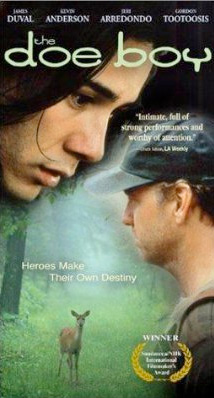
Week 5: The Doe Boy (2001)


The Doe Boy (2001)


Directed: Randy Redroad
Produced: Anthony Vozza, Chris Eyre, Jennifer Easton
Written: Randy Redroad
Rating: Not rated (language, minor violence)


"Hunter is a hemopheliac kid who lives in a rural area (the Cherokee Nation in Oklahoma) where hunting is important. As a youngster, despite his hemophelia, his father (Kevin Anderson) takes him on his first hunt. Alas, while his dad was napping, the kid killed a doe.


As a kid, Hunter is played by Andrew J. Ferchland; as a young man he's played by James Duval, who that same year was Frank in Donny Darko (2001).


For years after Hunter became known as "the doe boy" who couldn't tell a buck from a doe. And his maternal grandfather Marvin turned it into the humiliating story "The Hunter Who Shot a Woman."


I hugely admired Gordon Tootoosis's performance as the grandfather. It was first off a well written role & Tootoosis made it real. He's not your standard wise old romantic snow-haired Indian such as populate cinema when it tries to be "sensitive" toward Native Americans but can often come off annoyingly sentmental, such as Tootoosis could easily play with conviction. The epitome of that type was Chief Dan George as Old Lodge Skins of "Good day to die" fame in Little Big Man (1970).


As pure romance the archetype has definite appeal, but it's not real. By contrast, Marvin even while he does embody history & the wisdom of elders, he also seems like an actual person, not a "noble savage" cliche. He's a good guy but with crabby moments like anyone.


Tommy Deer-in-Water (James Smith, Jr.) is a top local hunter, whom Hunter greatly admires.


Young Hunter, whose very name should have defined his destiny, was never given a second chance to hunt. Yet his desire to be a hunter has never left him.


He has no desire to do it "white man style" like his father, dressing up like a tree & hiding with a high powered rifle. Rather, he wants to be like Tommy Deer-in-Water who only needs one arrow.


For the bulk of the film it's about a mildly dysfunctional family coping, loving, dreaming, hoping, a universal tale for any race, though mostly about Indian characters.


It's early in the year 1980, a time when a number of hemophiliacs contracted AIDs from contaminated blood.


Hunter has to be tested & while waiting for the results, he knows only that live or die, he goes on a hunt with one arrow. The tension between the worry & the intent provides several beautiful, beautiful moments.


It's hard to describe such a sensitive realistic film adequately as I fear my discription has made it seem like a soapy soft slice-of-life, when it's packed with amazing performances that reach the heart with truths & human struggles, never relying on sentiment or tearjerking tricks.


The film was a great success at Sundance & lauded at numerous film festivals including at the American Indian Film Festival where it swept awards for best film, best director, best lead actor (Duval), & best actress (Jeri Arrendondo who plays Hunter's Cherokee mom).


The effectiveness of such a fine script so well acted is enhanced by a wonderful soundtrack. The music is by native artists, across the board superbly chosen."

Wednesday, April 14, 2010

Week 3: Skins (2002)


Skins (2002)

Director: Chris Eyre
Producer: Chris Eyre
Writer: Adrian C. Louis, Jennifer D. Lyne
Rating: R (Language and violence)

By Frederic and Mary Ann Brussat

"Native Americans have always had a healthy respect for aspects of themselves that they would rather avoid. As an antithesis to the brave and bold tales of warriors, they told trickster tales about playful figures who did unmentionable things, were unruly and sexual, and spit in the face of tradition.

Skins, the second feature from Native American director Chris Eyre (Smoke Signals, 1998), is about what happens when a trickster spirit takes hold of a serious and self-righteous Native American and propels him on a strange and spooky ride. This incredibly fresh and engrossing drama shot on location in South Dakota on the Pine Ridge Reservation is one of the best films of 2002. Jennifer Lyne has adapted the screenplay from a 1995 novel by poet Adrian C. Louis, who was a teacher on the Oglala Sioux reservation. It’s a depressing place, the poorest county in the United States, with 75 percent unemployment, substandard living conditions, and rampant alcoholism. Those who live there have a 50 percent shorter life expectancy than other Americans.

Mogie Yellow Lodge (Nathaniel Arcand) and his younger brother Rudy (Chaske Spencer) grow up on the Pine Ridge Indian Reservation with an alcoholic father who repeatedly beats up their mother. Mogie, a star football player, takes care of his brother and is a hero figure to him. But when he comes back from Vietnam with three Purple Hearts, Mogie (Graham Greene) isn't the same person. He descends into alcoholism, spending days drinking with his buddy Verdell Weasel Tail (Gary Farmer) and nights in the local jail for disturbing the peace of the community. Often the person who locks him up is Rudy (Eric Schweig), who has become a cop. Aunt Helen (Lois Red Elk), matriarch of the Yellow Lodge, doesn't know what to do about Mogie. She knows he desperately wants to connect with his eighteen-year old son Herbie (Noah Watts) but lacks the will-power to do so.

While pursuing a teenage vandal in an abandoned house where a young man lies dead, Rudy falls down and hits his head on a rock. The trickster spirit, which he had met as a spider when he was 10 years old, suddenly takes possession of this serious young man. The dark side of his psyche manifests as a vengeance-seeking vigilante. Wearing a mask to cover his face, Rudy finds the boys who murdered the kid in the house and cracks their knees with a baseball bat. The trickster also encourages Rudy to have sex with a married woman (Michelle Thrash) and then compels him to torch a liquor store in another town that has been selling beer to Mogie and other Indians not able to purchase alcohol on the "dry" reservation. What he doesn’t realize is that his brother is on the roof of the place trying to break in to steal some beer. Mogie is badly burned, and Rudy is beside himself with guilt. He sees a local medicine man who says: "Human beings don't control anything, spirits do." He later invites Rudy to participate in a sweat lodge ceremony in order to get the trickster off his back.

Skins graphically depicts how poverty and alcoholism serve as divisive forces within families and within the community. Nearly at the end of his rope, Rudy is called to the backyard of a reservation home where Mogie's drinking buddy has gotten caught in a bear trap. The family responsible for putting this dangerous contraption in their yard try to justify this extreme measure as their only security against thieves.

After Mogie recovers from his burns, a doctor tells Rudy that his brother as cirrhosis of the liver and only a short while to live. The two brothers reach out to each other across the divide that has kept them apart for so many years. In the end, the trickster spirit helps Rudy pay tribute to Mogie's anarchistic spirit through an act of vandalism. Although some may be shocked by this image, it is an act of love that unites the brothers beyond the grave.

Skins is the kind of small movie that usually has a hard time finding a large audience. But this bold and cathartic drama set in place of great suffering and loss deserves to be experienced by those who cherish intimate dramas about individuals struggling against all odds to practice love, compassion, and forgiveness."

As this review noted, Eyre's solo project Skins and Alexie's Business of Fancydancing (Week 4), though good aditions to Native American cinema, are not as pivotal as their combined efforts on Smoke Signals. Though it is important to note they work best in tandem, their individual projects are stepping stones along the way to the increase in Native film.

Week 2: Smoke Signals (1998)


Smoke Signals (1998)


Director: Chris Eyre
Producer: Chris Eyre, Sherman Alexie
Writer: Sherman Alexie
Rating: PG13 (intense images and language)


"When it comes to American Indians, Hollywood either trades in Injun stereotypes or dances with Disney. Forget that. Smoke Signals, written and directed by Indians, also casts Indians as Indians. "No Italians with long hair," says Sherman Alexie, 31, the Indian poet, novelist and short-story writer who brings a scrappy new voice to movies with his first screenplay. And what a comic, profane and poetic voice it is. Alexie risks pissing off the PC cavalry as he explores the humor and heartbreak of being young and Indian and living on a reservation ("the rez") at the end of the twentieth century.

The road-movie plot springs from several stories in Alexie's 1003 collection, The Lone Ranger and Tonto Fistfight in Heaven Victor Joseph (Adam Beach) and Thomas Builds-the-Fire (Evan Adams), on-and-off friends since childhood and both now twenty-two, leave the Coeur d'Alenene rez in Idaho by bus and head for Phoenix to collect the ashes of Victor's father, Arnold, hauntingly played by Gary Farmer. Victor can't forgive the abusive, alcoholic Arnold for deserting him and his mother (Tantoo Cardinal) ten years before, Thomas can't forget how Arnold saved his life as an infant in a fire at home that killed Thomas' parents.

Cheyenne-Arapaho director Chris Eyre, a twenty-eight-year-old maker of short films in a striking feature debut, shows a keen eye for daily life on the rez. There are droll radio reports on weather ("It's a good day to be indigenous") and traffic ("Big truck just went by. Now it's gone"), Alexie knows the value of wit in deflecting an often stifling existence that eats away at self-esteem, family life and tribal traditions.
The contentious friendship of Victor and Thomas constitutes the core of the story. Well-placed flashbacks indicate how Thomas' knack for blurting out his thoughts has goaded Victor since childhood. "Hey, Victor," says the twelve-year-old Thomas after learning that Arnold has walked out on his family. "Your father left. What happened? Does he hate you?" Victor decks him for that one. He even tries verbal assaults. "I was wondering, Thomas," says Victor. "What color do you think your mother and father were when they burned up?" But Thomas, perpetually chirping, "Hey, Victor . . .," will not be dissuaded from questioning his friend on any subject that strikes him.

Everything about the smiling Thomas, with his geeky glasses, braids and nonstop storytelling, irritates Victor. On the bus to Phoenix, Victor tries to teach Thomas that being an Indian is not something you learn from watching Dances With Wolves. The point is to strike fear in the white man. "First, quit grinning like a idiot and get stoic," says Victor. "You've gotta look like you've just come back from killing a buffalo."

Thomas' transformation leads to a devastating encounter with two cowboys on the bus. "Find somewhere else to have a powwow," say the cowboys, who have stolen Victor and Thomas' seats. The Indians find new seats in order to avoid a fight, then try to retaliate by making up an insulting song about John Wayne's teeth. The scene shows just how foreign and hostile a country America can be to an Indian off the rez.

Beach and Adams give remarkable performances that grow in feeling and intensity. In Phoenix, Victor and Thomas meet Suzy Song (a tough and luminous Irene Bedard), the young woman who befriended Arnold and found his body. "We kept each other's secrets," Suzy tells Victor, though she does reveal one confidence that makes Victor see his father in a new light.
Smoke Signals doesn't pretend to solve the mystery between parents and children, or the clash between cultures that leaves Victor so angry and Thomas so eager to find stories that can heal wounds. No one listens to Thomas' stories. The same fate will not befall Alexie, who has crafted one of the best films of the year by finding himself in both Victor and Thomas and building something that will last."